 The Villages Golf Cart Repair
 Golf Cart Brake & Tire Service in The Villages
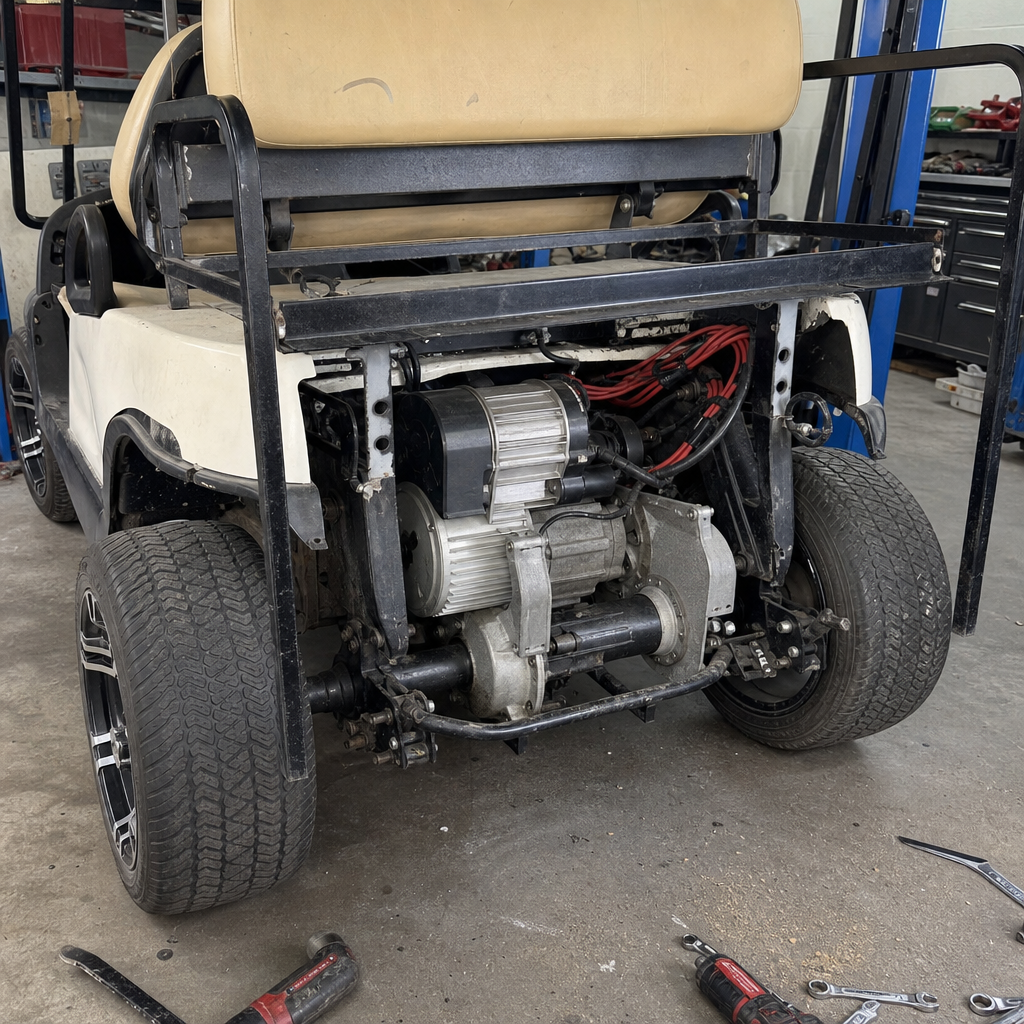
Golf cart brake work in The Villages runs $75 for an adjustment, $100–$250 for shoes and drums, and $200–$400 for a full overhaul; tires run $75–$150 each installed, $300–$600 for a set of four. Everything is done at your home, driveway or cart garage, anywhere in The Villages and the surrounding towns, with the service call applied toward the repair.
Brakes and tires are the most under-respected wear items in this community, and the reason is mileage. These aren’t golf-course carts. They’re daily drivers.
Villages carts wear brakes and tires on a car’s schedule
A cart that lives at a country club does a few gentle miles a week. A cart in The Villages does the morning run to pickleball, the Publix trip, the round at one of the executive courses, and the evening ride to the music at Brownwood or Sawgrass Grove, day after day, across 100+ miles of multi-modal paths. Many owners put more miles on the cart than the car. Every one of those miles wears the same consumables a car wears: friction material and rubber.
Add the terrain nobody thinks about. The tunnels under CR 466, CR 466A, Buena Vista, and Morse all have descents into them and grades out of them, which means braking on the way down, every single trip. Path intersections, crossings, and the stop-and-go around the squares mean a Villages cart brakes far more per mile than a course cart ever does. We wrote up the full picture in why Villages carts wear out brakes and tires faster than anywhere else.
Brake service: what we actually do
Most carts (Club Car, E-Z-GO, Yamaha, gas and electric) use mechanical drum brakes on the rear wheels, cable-actuated from the pedal. Three levels of service cover nearly every situation:
- Adjustment (~$75). Cables stretch and shoes seat. If the pedal travels farther than it used to before anything happens, an adjustment restores it. Cheap, fast, done in your driveway.
- Shoes and drums ($100–$250). Friction material is a consumable. When shoes wear thin the pedal goes long and stopping distances grow; when they wear through, metal contacts the drum and the repair doubles. Squealing or grinding means you’re due now.
- Full overhaul ($200–$400). Shoes, drums, cables, springs, and hardware. The usual candidates: high-mileage daily drivers, and snowbird carts whose brake hardware seized during a humid summer in storage, a genuinely common Florida failure. If your cart sat from May to October, have the brakes checked before the season; it pairs naturally with a tune-up.
One more Villages-specific point: if your cart is an LSV (capable of more than 20 mph, titled, plated, and insured) its brakes, lights, signals, mirrors, and belts are required equipment on a registered motor vehicle sharing roads posted up to 35 mph with cars. Brake condition on an LSV isn’t a judgment call. If you’re not sure which category your cart falls in, our golf cart vs LSV guide sorts it out in plain English.
Tires: worn rubber on wet paths
Villages tires die two ways. Daily drivers wear the tread off: squared-off centers, visible wear bars, shallowing grooves. Seasonal carts rot instead of wear: sidewall cracking from sun and age, flat spots from sitting loaded all summer. Either way, the risk is the same. Florida’s afternoon storm pattern leaves the paths and tunnel approaches wet for chunks of the year, and a bald cart tire on a wet downhill curve into a tunnel is how carts end up in the ditch.
Replacement runs $75–$150 per tire installed: turf-style, street tread, and the low-profile sizes on lifted and customized carts. We mount, balance where applicable, set pressures, and torque the lugs at your home. While the wheels are off we look at the brakes, because the labor overlaps and it’s the cheapest brake inspection you’ll ever get.
Swapping tread or size, not just worn rubber
A lot of our tire calls are not about wear at all. Someone bought a lifted cart wearing knobby all-terrain tires and wants a quieter street tread for the paths, or already has a set of wheels with tires mounted and just needs them swapped on. Both are short jobs. A pre-mounted set goes on with the lug nuts torqued properly; loose tires get mounted and balanced to your wheels first.
Two things are worth knowing before you pick a size:
- Read the sidewall. A size like 205/65-10 means a tire 205 mm wide, a sidewall 65% as tall as that width, on a 10-inch wheel, which works out to roughly 20.5 inches tall. A size like 23x10.50-14 states the overall height (23 inches) directly.
- Taller tires make the cart faster. At the same motor speed, top speed rises with tire height. Going from an 18-inch tire to a 23-inch one adds about 28%, enough to turn a 19 mph cart into a 24 mph one. Florida law (F.S. 320.01) defines a golf cart as one not capable of exceeding 20 mph; above that, up to 25 mph, the statute calls it a low-speed vehicle, which has to be titled, registered and insured. Ask us before a size change pushes a cart over that line.
On tread: aggressive all-terrain tires are louder and roll harder on pavement, which costs range on an electric cart. For a cart that lives on the multi-modal paths, a street or turf tread is the better match.
Signs you’re due
- Pedal travels noticeably farther before the cart slows
- Squeal, scrape, or grind when braking
- Cart pulls to one side under braking
- Parking brake won’t hold on a driveway slope
- Tread worn flat in the center, or cracks in the sidewalls
- The cart feels squirmy on wet path curves
Any one of these is worth a visit. All ranges are published on the pricing page, and if the diagnosis turns out to be something else, a dragging brake can even masquerade as a weak battery pack by loading the motor, we’ll tell you what we actually found.
Book brake or tire service
Tell us the brand, whether the cart is gas or electric, and the symptom, plus a photo of the tire if it’s a tire job. We’ll quote flat and come to you anywhere in The Villages, Lady Lake, Summerfield, Leesburg, and Wildwood, usually same-day or next-day.
Frequently Asked Questions
How much does golf cart brake work cost?
A brake adjustment runs about $75, shoes and drums $100–$250, and a full overhaul (shoes, drums, cables, hardware) $200–$400. All of it is done at your home, and the service call is applied toward the repair.
How often do brakes wear out on a Villages cart?
Faster than anywhere else, because carts here log car-like errand mileage instead of a few golf-course miles a week. A daily driver deserves a brake inspection every year; waiting for grinding noises means you're already replacing drums, not just shoes.
What do new golf cart tires cost?
$75–$150 per tire installed, or $300–$600 for a set of four, more for the lifted and low-profile styles on customized carts. We mount and install in your driveway.
Are brakes legally required to work on my cart?
On any cart, obviously, yes, but on an LSV (the 20-mph-plus, plated and insured kind, common in The Villages) brakes are required equipment on a registered motor vehicle, alongside lights, signals, mirrors, and seat belts. Brake work on an LSV is legal compliance, not just maintenance.
More golfcart services
Areas we serve
- The Villages, FL
- Mobile Golf Cart Repair in Belleview, FL
- Mobile Golf Cart Repair in Fruitland Park, FL
- Mobile Golf Cart Repair in Lady Lake, Florida
- Mobile Golf Cart Repair in Leesburg, Florida
- Mobile Golf Cart Repair in Oxford, FL
- Mobile Golf Cart Repair in Summerfield, Florida
- Mobile Golf Cart Repair in Wildwood, Florida